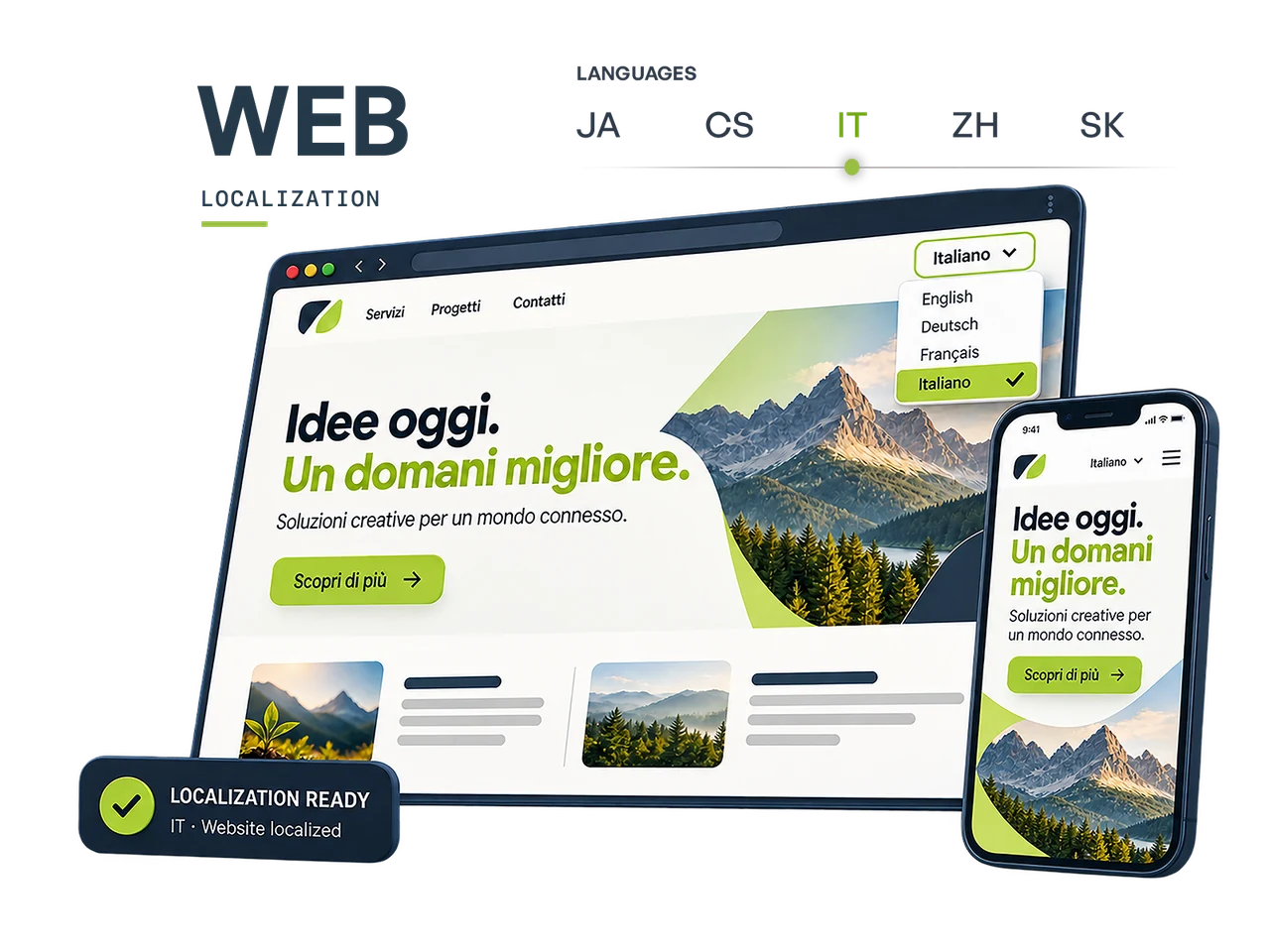
Scope of support / Web Localization
A new language needs a working website.
Website localization covers visible content, menus, forms, graphics and metadata. We agree which elements require translation and how they will be returned to the CMS.
Content audit and preparation
We create an inventory of pages, blocks and messages for localization, including navigation, buttons, forms, image alt text and SEO titles and descriptions. We agree how content will be handed over to your language team.
Translation implementation in the CMS
In WordPress, we work with tools including Polylang: linking equivalent pages, configuring language menus and implementing approved content. We also localize fields, blocks and messages within the agreed scope. For other CMS platforms, we adapt the approach to the site structure.
Graphics and text within images
We adapt illustrations, banners and screenshots containing text. Where source files are unavailable, we assess whether editable graphics can be reconstructed. We export assets according to website requirements and image optimization settings.
Responsive layouts after translation
We check longer headings, buttons, menus and forms on desktop, tablet and mobile. We adapt layouts within the agreed scope to keep language versions readable and free from overflow.
Metadata and language versions
We implement approved titles, meta descriptions, headings and alt text. We map equivalent pages and help configure canonical and hreflang references for available versions according to the site architecture.
Navigation, forms and checks
We check language menus, links, switching between equivalent pages and agreed form scenarios. We verify content completeness and language labeling and refer linguistic queries for approval.