Skip to content

07 / Web Localization

Website localization.
Content ready for new audiences.

We help implement language versions of websites, landing pages and WordPress sites. We combine content preparation with graphic, navigation and responsive layout adaptation.

Your team provides approved translations and market guidelines. We support the technical implementation of website localization and consistency checks across language versions.

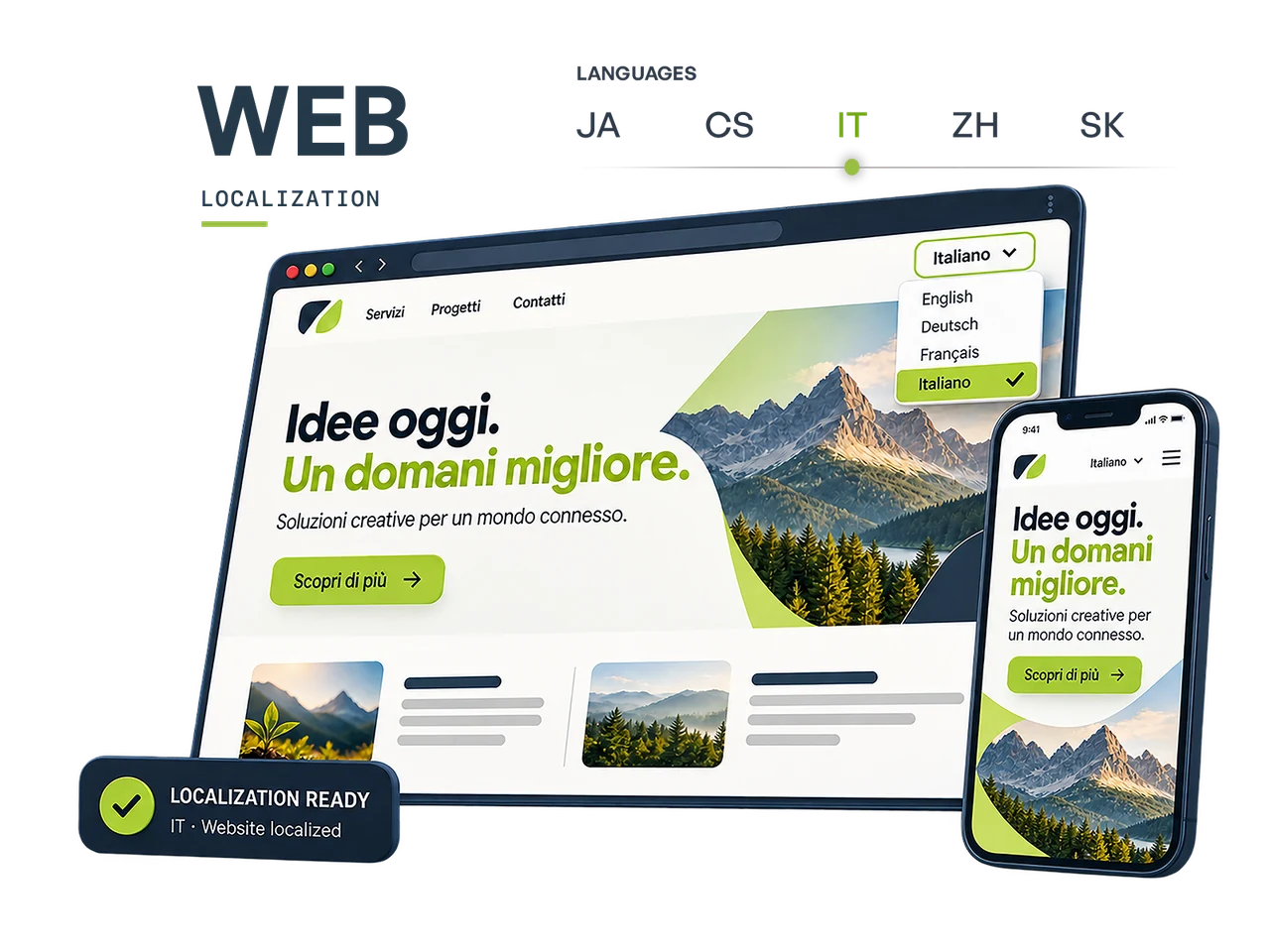
Web localization service illustration
07

Website Localization

Scope of support / Web Localization

A new language needs a working website.

Website localization covers visible content, menus, forms, graphics and metadata. We agree which elements require translation and how they will be returned to the CMS.

CONTENT

Content audit and preparation

We create an inventory of pages, blocks and messages for localization, including navigation, buttons, forms, image alt text and SEO titles and descriptions. We agree how content will be handed over to your language team.

CMS

Translation implementation in the CMS

In WordPress, we work with tools including Polylang: linking equivalent pages, configuring language menus and implementing approved content. We also localize fields, blocks and messages within the agreed scope. For other CMS platforms, we adapt the approach to the site structure.

GRAPHICS

Graphics and text within images

We adapt illustrations, banners and screenshots containing text. Where source files are unavailable, we assess whether editable graphics can be reconstructed. We export assets according to website requirements and image optimization settings.

RWD

Responsive layouts after translation

We check longer headings, buttons, menus and forms on desktop, tablet and mobile. We adapt layouts within the agreed scope to keep language versions readable and free from overflow.

SEO

Metadata and language versions

We implement approved titles, meta descriptions, headings and alt text. We map equivalent pages and help configure canonical and hreflang references for available versions according to the site architecture.

QA

Navigation, forms and checks

We check language menus, links, switching between equivalent pages and agreed form scenarios. We verify content completeness and language labeling and refer linguistic queries for approval.
How we work together

Clear responsibilities. Agreed approval points.

We adapt the scope to your project. Your team makes linguistic and subject-matter decisions, while KeboDesign handles the agreed production and technical checks.

Explore who does what:

Hover, focus or click to highlight the selected team’s responsibilities.

1Website analysis and quote

Your team

You provide the website URL or a copy, languages, page list and deployment requirements.

KeboDesign

We assess CMS structure and content scope and agree the localization approach, cost, schedule and working environment.

2Preparation and translation

Your team

Your team translates the text and approves content and SEO metadata.

KeboDesign

We can create a working copy, extract the content for translation and map it to CMS fields. We implement approved content on the copy before transferring it to the target website.

3Language version implementation

Your team

You confirm approved content, brand guidelines and any market-specific differences.

KeboDesign

We insert text and graphics, configure the agreed language navigation and adapt layouts.

4Review and responsive testing

Your team

Your reviewer checks the content in the website context and approves linguistic feedback.

KeboDesign

We test links, responsiveness and agreed form scenarios and implement approved corrections.

5Approval and handover

Your team

You approve the version and separately agree publication timing and scope.

KeboDesign

After approval, we transfer localized content and assets from staging to the target site within the agreed scope. We check language associations, links and forms and deliver the QA results.

Consistent language versions

A language switcher should lead to the right content.

Someone viewing a particular service should reach its language equivalent rather than always being sent to the home page. We therefore agree a page mapping and an approach for content without a translation.

In WordPress, we configure these associations using tools such as Polylang. Localization also covers menus, form labels, messages and metadata. We can copy a site, prepare the required content for translation, implement language versions and transfer agreed changes to the target site after approval.

Checkpoints

Discuss your requirements ↗

Deliverables / Web Localization

Materials ready for the next stage.

We agree formats and the final delivery scope in the brief. Your team receives approved deliverables with a clear handover.

For approval and deployment

Localized pages

Content and graphics implemented in the agreed CMS or test environment, with layouts adapted to the target language.

WordPress / CMS · text · graphics
For website maintenance

Language version and metadata map

An inventory of language equivalents and implemented titles, descriptions and navigation elements to support future updates.

Page map · metadata · languages
For publication checks

QA results and issue list

A record of responsive layout, link and agreed functionality tests, highlighting matters requiring a client decision.

Desktop · tablet · mobile · QA

Materials for a quote

What helps us plan the work?

  • The site URL or a working copy, together with pages and target languages.
  • Approved translations, SEO metadata and terminology guidelines.
  • Details of the CMS, such as WordPress with Polylang, available graphics and the current language setup.
  • Test scope, deadline, staging environment and approval and publication rules.

For an initial quote, the website URL, target languages and representative content are usually enough. After quote approval, we agree the required CMS access and, if copying or migrating the site, hosting and file access. We can prepare a staging copy, localize selected content and transfer approved materials to the target website. Transfer scope and publication timing are agreed before deployment.

Questions / Web Localization

Let’s define the right scope of support.

Do you support WordPress website localization?

Yes. We work with WordPress and tools such as Polylang to implement approved translations of pages, menus and other agreed elements. We analyze the theme, blocks and plugins to select a workflow and correctly link language equivalents.

Do you also provide website translation?

Your language team handles translation and content approval. We prepare materials, implement approved text and check the technical and visual aspects of localization.

Does your localization support include SEO?

We can implement approved titles, meta descriptions, headings, alt text and language associations. Target-market keywords and content need to be agreed with the client’s team.

Do you check websites on mobile and tablet?

Yes, according to an agreed set of views and scenarios. We focus on text readability, menus, buttons, forms and overflow after translation.

What if some content has no equivalent in another language?

We agree language-switching behavior and publication scope for that content. A page map helps identify missing equivalents and avoid unintended redirects.

Do changes go straight onto the public website?

They do not have to. We can create a website copy, prepare and localize selected content there and transfer agreed changes to the target site after approval. Access, migration scope, material protection and publication timing are agreed after the quote.

Contact / Web Localization

Let’s discuss your content, languages and project scope.

Send a sample or a link to your materials. We will define requirements, delivery formats and the information needed for a quote.

Go to the contact page ↗

hello@kebodesign.pl